The Youngest Naturalist, Apurba!! An Alternative Career
A career called Birding Guide/Naturalist (a student of natural history) is surely unconventional and very few, perhaps, could think of or aspire for. I keep meeting several interesting people in this unconventional field, but Apurba Sonowal (in the pics below) stands out to be strikingly different in his approach. First, he is the youngest naturalist I’ve ever met and worked with; second, he thinks ahead, thinks long term – that it’s a job/skill which needs to be learned working in the field, in a very hard way before he can get a proper table stake. Third, he is passionate and I mean it, quite passionate about nature and birding. More so, he is armed with new-age technology and a Graduate degree academically that supplements enough cognitive prowess.

With Apurba’s example, let me tell you what I think about the future and what this career can entail.
- NOTHING! if the passion is not there, don’t even try, at times it can kick the shit out…Be Aware! if you don’t dare don’t try.
- A LOT! if the skill is fully acquired, the reward is going to be a lot in the future wherein the general life and job of people are becoming mostly captive and inhouse. A naturalist will be demanded more (not just for birders) to connect them to nature practically and responsibly without abusing it. Hence, higher fees for the professional service. Matter of fact, with or without a guide the experience can be sky and earth different.
- The seasoned (5-10 yers+ experience) naturalists who worked their way up, are highly regarded and demanded, the fee they charge goes by their experience, name, and fame – The aspect I like most is that a naturalist LEADS! She/he may lead a single client to a diverse group from all across the globe.
- BTY, it’s not about the guiding only, it’s about managing the show, collaborating, organizing, and providing a professional experience that brings repeat clients. The higher the repo and business skills, the higher will be the remuneration on the table.
- In this age, there will be a lot many people from the cushion seeking jobs, hooked on to Google, FB, and Insta (let’s put me in the same boat) will want to see and share the real world/natural history which is way different than seeing it virtually. The point here is that exploring independently and being solitary without guidance will not be easy. Wherein most part of the young life goes in search of 99% (Mommy, Papa, Society all wants it that way) and then a great amount of time is spent in search of a jackpot career, post that mid-life goes on climbing the corporate ladder and rest in balancing work-life (wherein work overpowers Life). So, all of a sudden, climbing the real world ladder in search of life alone will be difficult – and these smart, refined folks globally will be the clients of the Guide/Naturalist.
- Job requirement/qualification: Passion for nature, wildlife, birds, mountains, forests and the ability to find it out working up-hill, downhill on feet, and traveling to remote locations (marks in exams not going to cut the cake, though more the education merrier it is)
- Performance and success measures: Ability to catch the “call of the wild” + integrity
Agree or not, to sum up…An alternative career or a dream job never comes or is given, one who goes for it, works for it, gets it.
Note:
- This write-up originates from my birding trip to the Michimi Hills, Arunachal Pradesh. Wherein, Apurba was my guide. The birding guide profession is still at a nascent stage and fast emerging as a mainstream career route with some already established their name quite well. It’s purely based on the credibility of the person and in no way a recommendation for a sure-shot career.
- Apurba provided his consent to share this story and pictures.

The Garden Elephants – A new age of Co-living
We’ve been talking about human-animal conflict for quite a long time now. Because, the rights of humans precede animals and borders are demarcated; whereas, in reality, it’s not. The equation of planet Earth and the term we know as ‘natural’ is changing too fast. With the rapid urbanization and scarcity of food and living space, it’s not just the human millennials of the new era who are embracing co-living for sharing space, experience, and food. It’s the rising universal need on earth that along with humans, animals are also adapting to this reality very very fast! This photo story captures how the so-called conflict is gradually transitioning (if not fully) into a new normal of co-living that is beyond our imagination of being ‘natural’. It’s incumbent on us to see the changing world, accept the reality, and make provisions accordingly for humans as well as animals to live in harmony.
I attempted to document the adaptive behavior of the giants on the earth, a large group of wild elephants. They regularly traverse through the forests into the villages, towns, highways, and tea gardens of Assam (East of India). In this process, they go through an enormous amount of interaction/conflict with humans. However, their growing intent and persistence to adapt and live with adversities by sharing the land that has been taken away from them are quite apparent. The pressure is so high from the elephants that the local inhabitants, most of them have already accepted their presence as a part of life, they call them Baba (God) and Dangoriya (the elder one) and the people who are aggravated (for good reasons) are rethinking ways to adapt.

Above, a group of wild elephants comfortably crossing a road with houses on both sides. The urban dwellers on both sides have accepted the regular visit, they know the timing and cautiously step aside paving ways for the elephants to cross. Even the domestic cow in this image who joined the giants in the parade seems very comfortable as the cow knows them well. With the rapid urbanisation, the unpaved road is now under construction, and sand gravel is laid, which will soon transform into a concrete road (see the video).

As the forest cover is shrinking, their food resources are depleting. However, some of the food they seek is found only in neighboring villages and urban areas. I believe the reason is more than hunger and shrinking living space; the taste of paddy, vegetables, salt, and local liquor to feel high are some overarching reasons that are often ignored. They are new age 21 Century elephants with more and more proximity to humans. As the human and the elephant population together are thriving and the invasion of forests continues, the distinction between human areas and forest areas is fading. Hence, they choose to venture out, at times in broad daylight. So much so that they not only discovered their pathways but dares to walk through the houses on both sides of the road, some of those are no more dirt roads but well laid out and included highways as well.

The group is foraging on a paddy field and they can clear many acres in a few hours; this is the major reason for the conflict with villagers as they need to deal with the crop damage and income loss. Of late, the idea of community farming to offer crop to elephants near the forests are being discussed, so that they stop venturing too far away from their main habitat. (Image shot by Rahul Baruah)
Large groups stay united mostly during their ventures into the human world, a solid deterrent against any measures and effort to push them away. For the elephants, it’s a new taste, the nutrition they need to add to live well. Hence, they are in a foray to expand their living space. Perhaps, it’s a sign that our forests are no longer remain as healthy as before. I named them garden elephants as they venture out from the forest to the tea gardens as their first safe habitat and then enter into the adjacent villages and the urban areas mostly at night. Once they are done with their mission they go back to the nearby forest cover every morning only to come back again, once the sun sets.(image shot by Rahul Baruah)


Ruling the road: They wait for the group to get together before barging onto this road all at once. The body language speaks for itself that we have the right on this path.

None of the houses, nor any objects are touched, the mission is just to peacefully cross path with humans. The end of the road is the forest where they spend the day and come back again in the evening by the same route.
The image below captures the last few in the group when they put up a power show once they reached the tail end of the road, thereafter the forest cover starts. By tightly holding each other the females in the group turn their faces towards the villagers and make a high-decibel grunt to show their authority as well as make it clear that together they are strong.

This stitch video above documents the story of this elephant group that chooses not to let go of its legacy and right on the land where they used to freely roam. Even though the natural dart track has been replaced with a concrete road with houses on both sides, elephants decided to continue their parade through it and made it clear that they wanted to co-live and live in harmony.
Eagle vs Vulture
A Tawny Eagle is toppling Lappet-faced Vulture mid-air. These are the largest in Africa (~12.5 kg) with a wingspan of ~ 3 meters.

These images depict a fight for food, an effort by the tawny eagle to save its hard-earned rodent kill on the ground that hungry vultures spotted from miles away. There were two tawny’s and they were feasting on it hiding it well inside the long grass. I was doing photography inside Tarangire National Park, particularly focusing on elephants. On our 1st day, during the afternoon I spotted a pair of Tawny Eagle busy eating something hidden inside the grass and decided to wait. Wherein the pair didn’t show up and was busy eating, I sensed some movement in the sky, those were tiny spots and I took no time to guess that they are vultures.
Though nothing was visible to me inside the grass I was waiting to see Tawny’s response thinking they’ll have to leave it to vultures. But it wasn’t the case; before the 1st vulture was about to land one tawny took off towards the vulture and confronted; others eagle continues to feast.

Tawny was one-third of the size of the vulture but the ferocity it hit the vulture the scavenger lost its balance completely.

Looking at the lost battle rest of the vultures landed far away, but by that time tawny pair finished and carried away the smaller leftover of the kill and disappeared.
Note: strictly avoid unauthorized use of any part of this website and the articles. Please reach out for info, questions, if any.
Raw Nature!
Nature takes its own course, we all know, but when a new life has to give in to others hunger, it’s heart-wrenching sight. These images show a raw nature.

On this planet, the life that thrives independently, which we called wildlife are driven by natural instinct. Many times, a new life just landed but never flourishes has given life to many becoming easy food. This real play of life and death unfolded right in front of me at the Ngorongoro Crater, Tanzania when a nomad lioness looked out for easy prey and picked up a just newborn wildebeest cub.
In the wild, the game of survival is not moderated and it’s RAW.
It was my 3rd visit to Africa. The reason, African landscape is often touted as the land to witness a thousand miracles, and I second that. Not that it doesn’t happen elsewhere but the unobstructed angle of view is really wide and open here; hence, I also chose to use wide-angle frame more and more. All the Images of this event that unfolded in split-second are shot using special photo techniques, angle, utilizing natural light and positing myself to get the extra effect, and it’s less about gears used.

Ngrongoro Crater floor (260 sq km) is a volcanic bowl that erupted and settled 2-3 million years ago which is a bed for mass animal paradise and undoubtedly a wonder in the world today. Also, next to it is another site called Olduvai George which is known for the early human evolution (Homo Habilis & Hominaide). So its a landmark of natural history and raw nature is preserved there. These images bear the story of two lion sisters, separated from the pride who were visibly hungry.

Lions that are out of their group or they have been pushed away for various reasons need to fend for themselves. This is when they go through the test of life being solitary. It can be deadly without having their group hunting cover/technique, and many succumb to this challenge. Most of the prey can outrun them on this open grassland.
It was the wildebeest calving season and a large number of wildebeest was present inside the crater with their cubs, but at the same time, we saw there were nomad lions and lioness all around, at least three places – these were separated folks. During my 1st visit (2016) also I saw a similar number of nomads inside the crater, which made me believe that they are deliberately selecting this place for easy prey. The crater is very dense with animals and covered by the crater wall. It’s like a small animal kingdom inside a bowl. Inside this, two lionesses which I called lion sisters, most likely so, was prowling and hungry visibly. We followed; wildebeest were all around and thought they’re chasing them. As we get closer, I realized that one lioness has already grabbed something on the ground and raked up a little mock fight with her sister who immediately moved away and parked herself some 100 meters away. As we maneuver to position ourselves, the 1st lioness stood up and walked towards us to reach her sister but carried a wildebeest newborn cub in its jaw. The Lioness who picked up the wildebeest cub was not interested to share the kill initially with her sister, clearly, it was not enough for herself. But, after some time she changed her mind and peacefully pass on the kill to her sister (see the video). It makes more sense to live together than alone, and they knew it well.

It was a sight, painful to see, but at the same time, I could feel two life could probably flourish at the cost of this new life that never flourished.
P.S. No unsolicited use of images or content of this website, please. Reach out for any further use.
An Expedition for The Himalayan Monal!
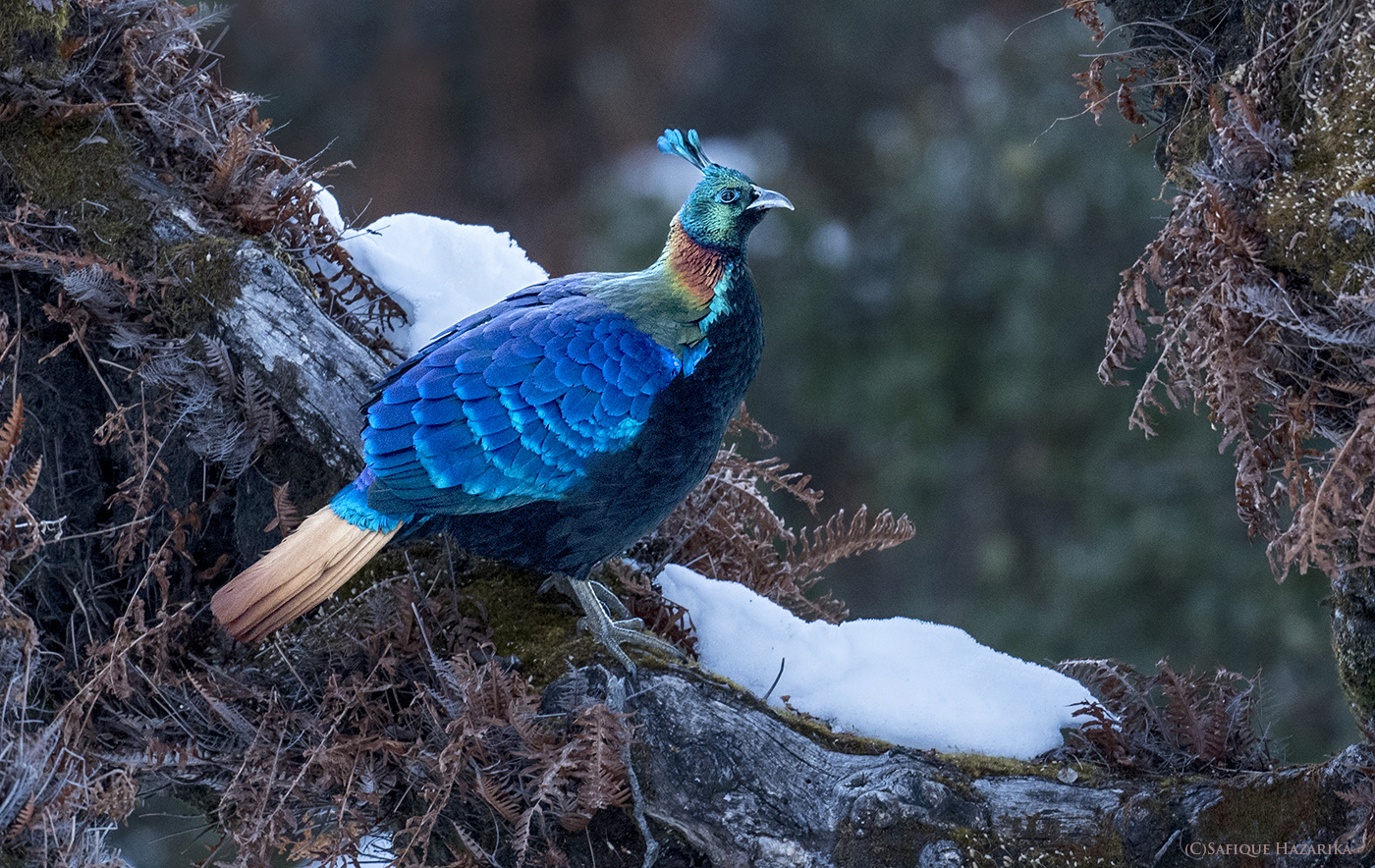
Mountains in India are mightier and the secrets it holds are known to very few. One of it is a bird, for those who have seen it instantly voted as India’s Most Beautiful Bird, i.e., the Himalayan Monal.

About The Monal – the way I see it.
Monals are native of Himalaya; hence, they are mountain birds (a large Pheasant), mostly found in Mountain slopes. As we know name pheasant embodies beauty, and they are found worldwide in different forms and colours (I am showing Scotland pheasant side by side below). But, the Monal particularly the male one has a royal touch, so much so that it can stumble you with its glossy multicolored layer on the body and a crest on top of its head – truly royal, and hard to describe in words.
Why an expedition?
The goal of my wildlife photography has been to show nature’s beauty in the best possible way. Sounds simple, but it ultimately boils down to the choice of angle, light, locations, situations, courage, intuitions, patience, more so bite the dust, dirt, snow and what not :). With this backdrop and to accomplish my Monal dream, I set out for an expedition, not just to get a photo but to frame the royal bird on the snow, as I believed snow/white truly complements and brings out the features that this legendary bird is known for. But, it was easier said than done, Monal inhabits up to 14800 ft high and getting them on the snow means it has to be towards the higher altitude and during the peak winter months. The plan was chalked out for the end of December 2019 to venture in Kedarnath side of Himalaya covering Tunganath and Chandrasila peak. This was my 1st wildlife trip wherein this time my backpack, hand packs all were filled up to the brim with not only camera gears but with mountaineering staff along with the shark teeth (crampons) as I was hell-bent to find the Monal on the snow :).
About the Journey.
The journey from Hyderabad was an epic arduous and never-ending one. The easiest part was a direct flight to Dehradun but that wasn’t the end of the story, there onward it was a 14-hour journey by car via Rishikesh and Rudraprayag. The good part was the beautiful view of the mighty river Ganga stayed along throughout the most part of it. The journey put me in my 1st base camp (Mandal Village) in a single day, from merely sea level to 8700 ft altitude, also transposing the body and my camera gears from 30* C to -10* C in a single day. The Chopta (popular hill station, Uttarakhand) area I crossed in the mid of the night was already under heavy snow. Looking at it I was a bit happy with the prospect, but little did I know there was more breaking the ice moment waiting ahead.
The mission.
The next day early morning, my guide Harish Maithani woke me up. His appearance was a voila moment like the eagle has got its eyes :). It is extremely important to have an experienced birder along. But, he had news that due to fresh heavy snowfall Monal might be difficult to find, they don’t get food easily on the snow, particularly the male one that I was interested in is relatively shy. I realized that finding the snow is one thing but finding the Monal on the snow is now going to be like finding a needle in the hay stake. Alas, we started our day to scan the grassland areas 1st, even though I may not get snow there, but I was desperate to see one.
It’s mainly the mountain slopes we started scanning using binos, moving from one place to another, and there it was, Harish pointed our 1st but a female Monal.

Female looks big sized Frankolin, as I saw them live 1st time, looks good but my curiosity for the male has gone up even further because that was my target. For the next three days, we kept searching like a miner looking for gold, but we got all female and female, then came the eureka moment as something colorful flew with big wing-flapping noise, that caught our attention. I looked at Harish and he whispered. . . it’s a male :). I hold my breath and crossed checked our strategy as I wanted to get a close shot, not the record shot. We decided to watch the movement 1st, bird landed on a slop little 100 meters away but immediately started moving up towards another slope with loud calls, I sensed what the meaning of those calls as there were females on the other slope, for that he needs to cross the road. I also knew, his road crossing will give me an eye-level shot if I can catch. The first time I realized my marathon skill will be so handy in birding as well, I actually sprinted lugging the camera gears along. I was completely hidden from the bird as it was on the lower slopes and I reached very closed. Somehow holding the breadth lied down flat on the ground for an eye-level shot I wanted, but the fortune didn’t favor, time was too less before I could even place the camera, the Monal appeared and saw me, 10 meters away. It was a magical bird, the glossy colors oozing out o the body. I knew any single movement or effort to fire the shutter will make the bird vanish. Without removing the eye contact, the Monal crossed being alert by holding its body and crest high towards the higher slopes. Next moment I snapped at least 100 images.

While clicking on the slopes I realized that the challenge was to get an ideal shot; grass obstructs, the background was not clear, more so, there was less snow. The 4th day I convinced Harish that we’ll go higher up and put up bird hide on the snow if required in the areas where Monal roams.
We trekked up the Tunganath area and curved out our 1st hide. It was -10*C, fortunately I was well prepared including having warm water with a thermos flask.

A short video describing the expedition
Moving higher up was the right decision, as the morning broke out, we saw several monals on the tree and stayed put on the knee-deep snow. After some time hide proven to be extremely fruitful as few of them crossed one tree to another walking over the snow. It gave me some time to work on my exposure, as shooting in snow is very challenging with the glittering white background with a glossy colorful bird the entire metering system gets confused. But, here is the best I could shoot at a groud level, full-frame, full-on snow.


More images from the Kedarnath area.


With success, I decided to move even further as there were chances of getting Snow Partridges that rarely come down below 13000 ft (4000 meters). Luck that day was enormous, I shot this from a very difficult snow-clad mountain ridge just before reaching the Chandrasila Peak.

Photographing in snow requires tremendous effort, and at times it goes beyond the camera & skill. I must thank Harish who was my eagle eye and himself is a very passionate, experienced super-fit birding guide who helped to figure out the probable spots/locations. Here is a video interview with Harish “Birding From a Guide’s Point of View”.


Wild Camping – Botswana (Video)
In Search of a Tiger – Tadoba Andheri Tiger Reserve

My indulgence with the jungle books of Jim Corbett during school days would often transpose me to the dreamland of Big Cats. The ‘Call of The wild’ never stopped echoing in my mind and, years later, the curiosity led me to several off the beaten paths in search of a tiger—just to shoot the elusive beast, but with a camera 🙂
Corbett — in his book ‘Man-Eaters of Kumao’— says, “A tiger is a large hearted gentleman with boundless courage and when he is exterminated—as exterminated he will be, unless public opinion rallies to his support—India will be the poorer by having lost the finest of her fauna.”
Corbett’s words turned prophetic; the tiger population in India was almost on the verge of extinction and less than 3000 grace our forests today. In such a scenario, catching a glimpse of these wild cats in a vast forest is like finding a needle in the haystack. However, it is indeed possible with the right set of information, passion, and patience.
Some of the popular places for Tiger sighting in India are Jim Corbett National park, Ranthambore, Bandhavgarh, and Kanha. But, the one I would like to introduce, which has also become my favorite over ten years is Tadoba Andhari Tiger Reserve—the reason being this less known forest in central India is increasingly becoming populated – not with people but with tigers. It is now a popular Tiger habitat with almost 40-45 tigers (according to the 2013-14 census) living in the core and nearby buffer areas (relatively a small area than the 1000 square KM dense forest).

What makes Tadoba more interesting is its diverse animal and prey base. Besides tigers, the place is home to two other hard-to-find predators, i.e., leopard and the wild dogs (Dholes) – you have an equal chance of sighting them, though leopards are too elusive. It’s a dry deciduous forest full of bamboo shrubs, which serves as an ideal camouflage for tigers to stalk their prey easily without getting noticed. There are several other animals
that inhabit this forest—various species of deer (spotted, sambar, barking and blue bulls), sloth bear, wild boar, bison, crocodile and various type of birds; enough to keep any nature lover excited with everything Tadoba has to offer in this hidden treasure.
How to track and see a tiger?
Nobody can ensure a tiger sighting, but there is a lot one can do to increase the probability of a sighting.

Tigers are solitary animals, stalkers, and the leader of the forest; they are very quiet and elusive. One of the ways to track these wild cats is to observe the behavior of other animals in the forest—whenever a tiger moves or is in the vicinity, other animals give a distinctive panic/alert call, deer appear nervous and look at one direction, and monkeys jump on a treetop and make a peculiar sound.
Tigers are fond of water and loves playing in the water. Also, they don’t have sweat glands; hence, especially during peak summer when water becomes scarce, they are likely to come to the waterholes/ ponds at least a few times a day – and this becomes the hot spot for tiger sighting.
Though tigers are solitary, a family with newborn stays together for up to two years, so if there is news of a family in a particular area, the chances of sighting a tiger in that area are very high. Cubs are the bold, inquisitive and most playful ones, and fun to watch.
How to visit Tadoba or nearby places?
Tadoba located in Chandrapur district of Maharashtra in central India, just 135 km from Nagpur. Nagpur is well connected to major Indian cities by air and rail. From Nagpur, one can reach Tadoba easily by road.
Nagpur is known as the hub of wildlife in India—in addition to Tadoba, one can also visit Pench, Nagzira, Umred-Kharhandla, Kanha, and Bandhavgarh.
Where to stay and book a permit for safaris?
There are different gates for park entry—Mohrali, Kolara, Kolsa, and Navegaon; the first one is the most preferred because of easy accessibility and accommodation options. There are two resorts run by the forest department—MTDC Tourist Complex and Eco-Tourism complex; booking to both can be made through their websites are given below:
It is important to note here that bookings should be made well in advance to ensure that you don’t face reservation hassles.
The Tourist Complex is surrounded by forest and water bodies with lots of birds; it is a place where one can enjoy the joys of nature with the shrill of birds, deer calls, and even growl of Tigers.
There are other private resorts, though the options are limited; resort Tiger Trail, Serai, and Saras can be a good alternative depending on budget.
Do not forget to book the safaris online from Mahaecotourism; it is easy and hassle-free. There are various ranges in the park—book Mohrali range if you are staying in Mohrali; if unavailable, select Khatunda gate. The vehicle, an open six-seater jeep with a guide, needs to be booked separately.
Time to Visit?

Though the park remains open round the year, only the main road is accessible during monsoon (July-September). The comfortable time to visit is October-February when the weather is good and the forest has a lush green cover. summer (March-June) is the time when maximum tiger sighting happens; however, the temperature can reach 45° C during the period.
Given the diverse and rich flora and fauna, a fulfilling trip is guaranteed in Tadoba. For those who like to explore off the beaten path and for those who like to enjoy the unique eco heritage of this country, this is the place to visit. And, if you happen to meet the large-hearted animal, do share the thrill with others, spread the word and make people aware of the need to save these majestic beasts.
Tadoba Gallery


Total views : 10892